Welcome to the third post in the “Strange but Sacred” series, a Bible study where we look at the odd, overlooked, and sometimes puzzling stories of the Old Testament—and what they can still teach us today.
Read: 1 Kings 12:25–13:30
Some Bible stories comfort us.
This one unsettles us.
It involves a fearful king, a lying prophet, a faithful messenger… and a lion standing beside a body on a road. And when you finish reading it, you will want to protest: That feels harsh.
But this strange story isn’t really about punishment.
It’s about obedience.
A King Who Tried to Help God
After Solomon died, Israel split into two kingdoms. Rehoboam ruled Judah in the south, and Jeroboam became king of Israel in the north.
Jeroboam faced a dilemma: his people still had to routinely travel to Jerusalem in Judah to worship God. Worried his people would grow fonder of that king, he decided to fix the spiritual issue with a political move.
After some spectacularly bad advice, he built two new worship centers—one in Bethel near the southern border and one in Dan in the far north—and made golden calves, announcing:
“It is too much for you to go up to Jerusalem. Here are your gods, Israel, who brought you up out of Egypt.” (1 Kings 12:28 NIV)
Yes, two golden calves.
Like the one from Exodus 32.
And it didn’t go well then either.
Jeroboam went further by appointing his own priests, creating new shrines, and even inventing his own religious festival. He didn’t reject the idea worship — he simply redesigned it. Because a convenient religion is much easier to control than true obedience.
The Man of God
God sent an unnamed man of God from Judah to confront him. As Jeroboam stood at the altar, the prophet cried out:
“Altar, altar! This is what the Lord says…” (1 Kings 13:2 NIV)
He foretold that a future king, Josiah, would destroy this false worship. Then he gave a sign: the altar would split apart.
Jeroboam reacted the way many powerful people do when confronted — he pointed and ordered the man to be seized. But …
Immediately, his hand shriveled.
At the same moment, the altar split open.
Naturally, the king’s anger turned into panic.
“Intercede with the Lord your God and pray for me that my hand may be restored.” (1 Kings 13:6 NIV)
The same hand that had just pointed in rage now needed mercy.
The man of God prayed — and God healed him.
Jeroboam then invited the prophet to eat and offered a reward. But the prophet refused:
“I was commanded by the word of the Lord: ‘You must not eat bread or drink water or return by the way you came.’” (1 Kings 13:8–9 NIV)
He passed the king’s test.
But he was about to fail a different one.
The Old Prophet
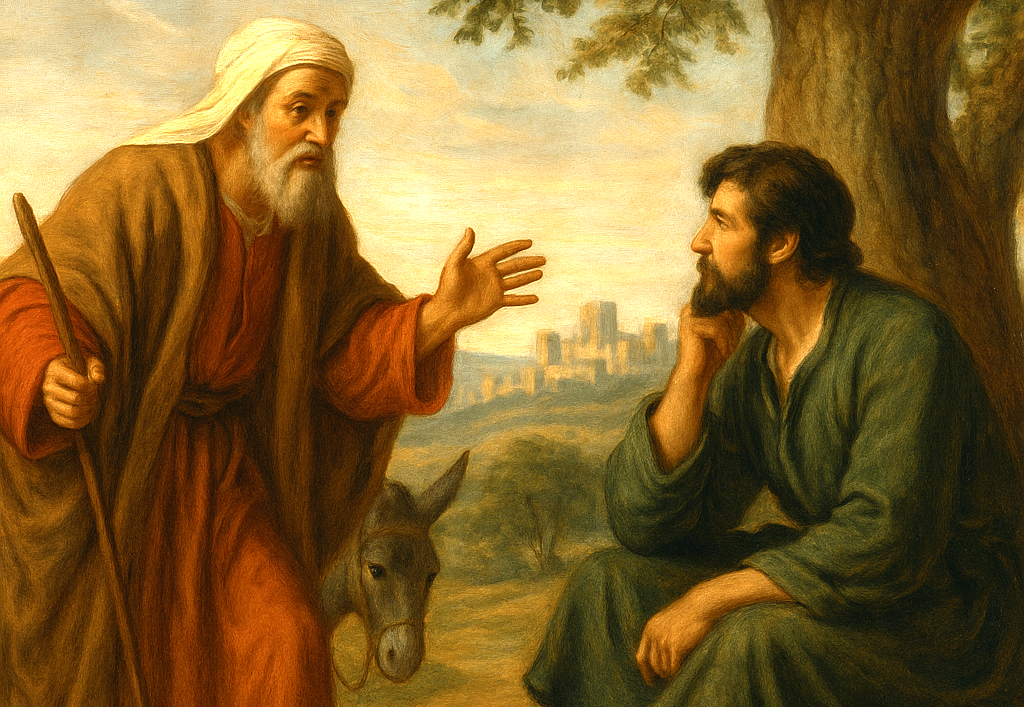
After leaving Bethel, the man of God stopped to rest under an oak tree. Nearby lived an old prophet. When his sons, who maybe witnessed or heard about the ordeal, told him what had happened, the old prophet hurried to find the man. Then he invited him home for a meal.
The prophet refused and repeated God’s command. So the old prophet tried again:
“I too am a prophet… and an angel said to me… bring him back with you.”
(1 Kings 13:18 NIV)
Scripture immediately adds:
But he was lying.
Here’s what makes the moment understandable. In that culture, sharing a meal wasn’t just food — it was acceptance, friendship, and peace. Refusing hospitality could feel deeply offensive. And now another prophet claimed God had updated the instructions.
And the man of God believed him.
The Turning Point
While they were eating, the real word of the Lord came — this time to the old prophet.
“You have defied the word of the Lord… therefore your body will not be buried in the tomb of your ancestors.” (1 Kings 13:21–22 NIV)
That meal must have ended quite suddenly.
On his way home on the old prophet’s own donkey, the man of God came upon a lion and was killed. Weirdly, the lion did not move or eat the body, and it did not harm the donkey. Instead, the lion and the donkey both stood beside the body on the road.
This was not an accident.
It was a sign.
Passersby witnessed the strange sight and carried the news back to Bethel. When the old prophet heard, he set out at once to find the man. Upon arriving at the scene, he broke down in tears.
And we are left asking the same question:
Why such a severe outcome?
What This Story Teaches Us
This story feels severe because it confronts a truth we don’t naturally like:
partial obedience is still disobedience.
- God gives clear instructions. He wants us to trust Him enough to take His Word seriously. “To obey is better than sacrifice.” (1 Samuel 15:22 NIV)
- Using spiritual language doesn’t always mean spiritual truth. If a message contradicts God’s Word, it isn’t from God — no matter who says it. “Do not believe every spirit but test the spirits.” (1 John 4:1 NIV)
- Victories are often followed by new temptations. The greatest danger often comes after we think the battle is over. “Your enemy the devil prowls around like a roaring lion.” (1 Peter 5:8 NIV)
- God’s commands are not arbitrary, they are protective. Even when we don’t understand them, they guide us toward life and peace. “Trust in the Lord with all your heart and lean not on your own understanding.” (Proverbs 3:5–6 NIV)
This strange story reminds us that God’s instructions are sacred and meant to guide us, not burden us. The man of God’s mistake wasn’t defiance—he listened to a voice that seemed right instead of the Word he already knew to be true. We can face that same decision every day. And thankfully, the same God who warns us also patiently teaches us to trust Him, one choice at a time.
Questions for Further Study
- The man of God obeyed God when facing the king but disobeyed after hearing another prophet. Why do you think one situation was easier to resist than the other?
- The old prophet claimed God gave him a new message that contradicted the first one. How can we recognize when advice, teaching, or spiritual guidance does not truly align with Scripture?
- Why do you think God gave such specific instructions (“do not eat, do not drink, do not return the same way”)? What might those instructions symbolize for believers today?
- Have you ever experienced a time when something sounded reasonable or spiritual but later proved to be wrong? What helped you recognize it?
Disclosure: The featured photo was created by AI to depict an aspect of this story. Scriptures marked NIV are taken from the NEW INTERNATIONAL VERSION (NIV): Scripture taken from THE HOLY BIBLE, NEW INTERNATIONAL VERSION ®. Copyright© 1973, 1978, 1984, 2011 by Biblica, Inc.™. Used by permission of Zondervan.