
Welcome to the second post in the “Strange but Sacred” series, a Bible study where we look at the odd, overlooked, and sometimes puzzling stories of the Old Testament—and what they can still teach us today.
Read: Joshua 10:1-15
Ever wished for a pause or rewind button—like when you’re running late for an important meeting, or waiting just one more day when your kids were little? We’ve all had moments when we longed for more time.
But did you know there’s a story in Scripture where God actually made that happen?
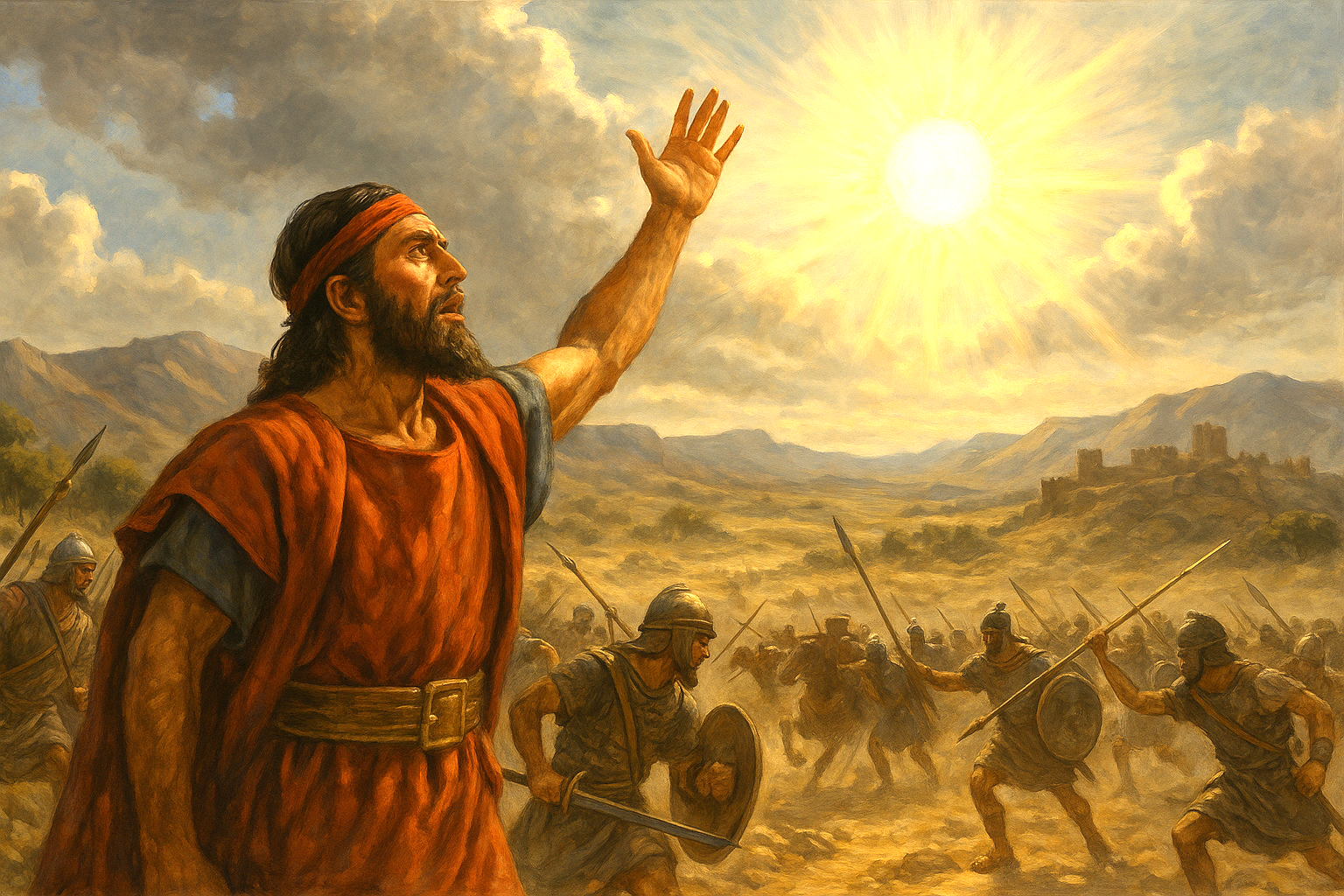
Around 1406 BCE, on a distant battlefield, the fate of a nation hung in the balance. Instead of setting, the sun seemed to defy the coming darkness and pause in the sky.
This event is plainly recorded in the Old Testament. For centuries, people have wondered: Was it a natural occurrence, a misunderstood incident, or a miracle that defies scientific explanation?
No matter how one wrestle with the details, the message is clear: when God acts, even time pays attention.
Exceptional Faith in Battle
Shortly after Israel entered the land of Canaan, they made a covenant with the Gibeonites. Enraged by this alliance, five Amorite kings joined forces to attack Gibeon.
True to his word, Joshua prepared to lead the Israelite army in defense of their new ally. Before setting out on the overnight march to Gibeon, God offered Joshua reassurance:
“Do not be afraid of them; I have given them into your hand. Not one of them will be able to stand against you.” (Joshua 10:8, NIV)
At sunrise near Gibeon, the Israelites’ attack caused chaos throughout the Amorite camp. As they fled, God intervened in a dramatic way—hailstones rained down, killing more enemy soldiers than Israel’s swords.
Yet the battle was not finished.
With victory promised but daylight slipping away, a confident Joshua prayed aloud:
“Sun, stand still over Gibeon,
and you, moon, over the Valley of Aijalon.” (Joshua 10:12, NIV)
And God answered. Scripture tells us the sun stopped, the moon stood still, and the day was extended until Israel achieved complete victory.
Why this Story is So Extraordinary
Two supernatural events occur in the same battle:
- Hailstones fell on the enemy, killing more Amorites than the Israelites (Joshua 10:11)
- The sun and moon stayed still until the victory was won (Joshua 10:12–13)
While puzzling, Scripture gives the clues that help us understand what this was—and what it was not.
Not a Metaphor
The author of Joshua points to the Book of Jashar* as another record of the event, suggesting it was known and remembered, not merely symbolic language.
Not an Eclipse
Some believe this event was a solar eclipse, but the description doesn’t fit the pattern of an eclipse or any typical astronomical occurrence.
- Both the sun and the moon stopped, making it likely that each was visible.
- An eclipse darkens the sky, but this event extended daylight
- During an eclipse, the moon continues moving; here it’s described as standing still
A Singular Moment
Scripture makes a remarkable claim:
“There has never been a day like it before or since.” (Joshua 10:14, NIV)
Centuries later, the prophet Habakkuk still remembered it:
“Sun and moon stood still in the heavens…” (Habakkuk 3:11, NIV)
To Israel, this was not a myth but a real and holy moment—an act of God so profound it was remembered for generations.
What this Story Teaches Us
This biblical story has plenty of lessons that are still relevant for us today:
- Faith acts on what God has already said. God promised Joshua victory and Joshua prayed boldly and with confidence.
- God supplies what we lack. Israel needed more than strength or strategy—they needed time. God provided exactly what was necessary.
- God is greater than anything people can put their trust in. The Amorites honored the sun and moon, yet those same heavens were under the command of the true God. What others treated as powerful proved powerless before God.
- God is not bound by time. We often feel late, behind, or out of opportunities, but God operates beyond deadlines, seasons, and human timetables.
- Delays are not defeats. When God is at work, waiting does not mean failure—and darkness never has the final word.
The same purposeful God who held the sun in place is still working within your story. Nothing you have lived through has put you beyond His timing, and nothing He has planned for you is too late to begin.
Questions for Further Study
- What part of the story in Joshua 10 stood out to you the most—the hailstorm, Joshua’s prayer, or that time stood still? Why did that detail catch your attention?
- God promised Joshua victory before he even left on his mission. How do you think that promise affected how Joshua prayed his prayer?
- Joshua asked for more time in order to finish what God had called him to do. Is there an area of your life right now where you feel rushed, behind, or out of time?
- How would your daily worries change if you truly believed God is not limited by timing, deadlines, age, or season of life? What step of faith might that encourage you to take this week?
*The Book of Jashar was likely an ancient Israelite collection of historical songs or heroic poems. Joshua did not quote his prayer from this book. Instead, the writer of Joshua mentions it as an additional record of the event, similar to citing a known historical source. The miracle was remembered well enough to be preserved outside the biblical text. The Book of Jashar is also referred to in 2 Samuel 1:18.
Disclosure: The featured photo was created by AI to depict an aspect of this story.
Scriptures marked NIV are taken from the NEW INTERNATIONAL VERSION (NIV): Scripture taken from THE HOLY BIBLE, NEW INTERNATIONAL VERSION ®. Copyright©1973, 1978, 1984, 2011 by Biblica, Inc.™. Used by permission of Zondervan
References: (1) Bible Learning Institute Ministries, (2) Bible Hub, (3) Got Questions









I’d love to hear what you think!