
Welcome to the fourth post in the “Strange but Sacred” series, a Bible study where we look at the odd, overlooked, and sometimes puzzling stories of the Old Testament—and what they can still teach us today.
Read: 2 Kings 20:8–11
Some Bible miracles happen in front of crowds — seas part, fire falls, armies flee. But this one took place in a quiet room. A king lay sick, newly told he would die, and turned his face to the wall to pray. No audience. No spectacle. Just a desperate, honest prayer.
And in response, God answered in a way that was both strange… but sacred.
King Hezekiah’s Choice
King Hezekiah of Judah was about 39 years old when he fell deathly ill. The prophet Isaiah (yes, the same one from the book of Isaiah) came with devastating news: Hezekiah would not recover. He was to set his house in order and prepare to die (2 Kings 20:1).
Hezekiah immediately turned his face to the wall and prayed.
Scripture tells of a deeply honest prayer. He didn’t speak like a king addressing a crowd, but a man staring death in the face—pleading with God and weeping bitterly (2 Kings 20:3). His distress went beyond the fear of dying. At the time Hezekiah had no son or heir, and God’s covenant for King David’s dynasty seemed to be in jeopardy. There was also the growing shadow of Assyria, and the loss of Judah’s king may leave the nation vulnerable and uncertain about its future.
Before Isaiah even left the palace courtyard, God stopped him:
“Go back and tell Hezekiah, the ruler of My people…’I have heard your prayer and seen your tears; I will heal you. On the third day from now you will go up to the temple of the Lord. I will add fifteen years to your life.’” (2 Kings 20:5–6, NIV).
Here is a detail we can miss: Hezekiah’s prayer was answered before the prophet could even reach the outer parts of the royal residence.
When Isaiah returned to the king, he directed that a moist poultice of figs be applied to the king’s boil to help ease his ailment. This marks the first mention of the king’s illness, likely an infection or skin disease (2 Kings 20:7).
Then Hezekiah asked a question: “What will be the sign that the Lord will heal me?”
What Isaiah says next is remarkable. “This is the Lord’s sign to you that the Lord will do what he has promised: Shall the shadow go forward ten steps, or shall it go back ten steps?”
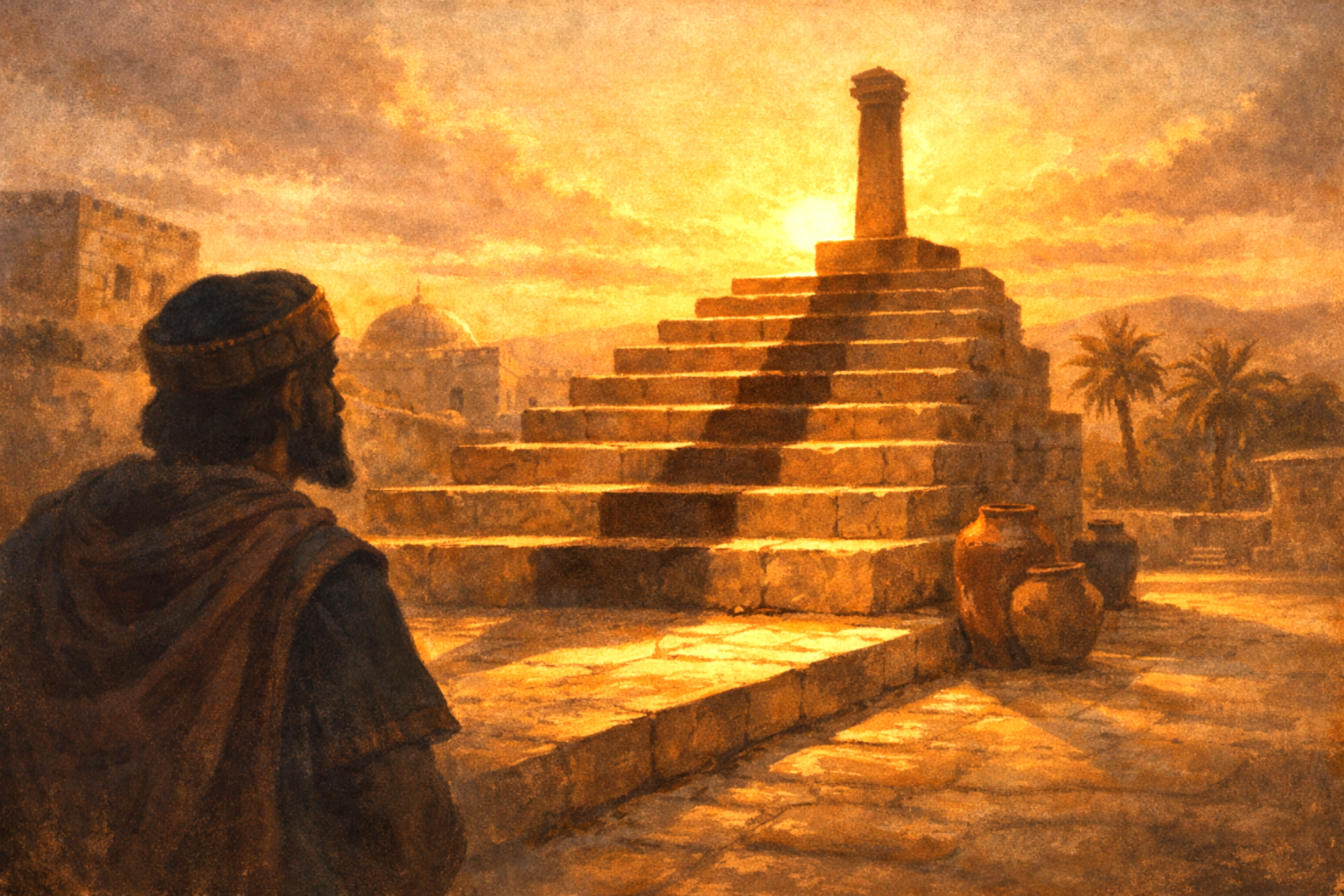
Isaiah was referring to the stairway of Ahaz —likely a stepped sundial used to track the sun’s movement. The shadow could move forward ten steps…or backward ten steps.
Forward would be normal.
Backward would be impossible.
Hezekiah answered immediately: “It is a simple matter for the shadow to go forward ten steps. Have it go back ten steps.”
Then God did something extraordinary.
The shadow moved backward.
Why This Is So Extraordinary
It’s easy to skim over this miracle and not realize just how astounding it really is.
The shadow moving backward wasn’t merely a trick of light. A sundial works by the predictable movement of the sun across the sky. Shadows do not reverse direction unless the movement of the sun — or the earth itself — is altered.
Hezekiah deliberately chose the harder sign, ruling out any chance of coincidence. He sought a confirmation only God could give.
Then God altered the observable order of creation for one man who was afraid and needed reassurance.
The Scripture hints that the event may have been noticed beyond Judah. Babylonian envoys later arrived to look into the “sign that had occurred in the land” (2 Chronicles 32:31), and even those far away seemed to sense something unusual had taken place.
But God’s purpose wasn’t astronomy.
It was mercy.
What this Story Teaches Us
This biblical story has plenty of lessons that are still relevant for us today:
- God is not impatient with sincere questions. Hezekiah asked for reassurance, and God did not rebuke him. Faith and fear often exist in the same heart.
- Prayer matters more than we think. God changed His announced outcome after Hezekiah prayed. Scripture openly shows a God who listens and responds.
- God works through both natural and supernatural means. The poultice treated the illness, but the healing came from the Lord. Medicine and miracles can work hand in hand.
- Our perspective is limited; God’s timing is not. The One who created time is not controlled by it. What feels final to us is not final to Him.
When Faith Wants Proof
Even with the message that he would be healed, Hezekiah asked for proof.
He was afraid, told he would die, and longed to know there was still hope. God didn’t scold him; instead, He offered reassurance.
God didn’t need to move the shadow—His promise alone was enough. But in His mercy, He met a worried heart and gave a clear sign that His word could be trusted.
We know that feeling well. We pray, yet part of us still wonders, Lord… will You really come through? Sometimes God offers clear reassurance — a prayer answered, strength we didn’t have before, peace in the midst of uncertainty. Not because our faith is perfect, but because He is kind.
We should remember that the heart of this story isn’t the sign itself. The real miracle is that the God who governs time listens to our prayers.
We don’t always get visible proof, and most days we have to live by trust rather than sight. But the Lord has already given us a lasting sign of His faithfulness—the Cross—which reminds us that His promises hold true, even when we can’t yet see how things will turn out.
Our hope is not in signs we can see.
It rests in a faithful God who keeps His word.
Questions for Further Study
- Why do you think God granted Hezekiah a sign instead of asking him to simply trust?
- When have you wanted proof that God was going to answer a prayer?
- Do you tend to feel guilty when you ask God for reassurance? Why or why not?
- What does this story teach us about the relationship between prayer and God’s response?
- How can we grow in trust even when God does not give a visible sign?
Disclosure: The featured photo was created by AI to depict an aspect of this story.
Scriptures marked NIV are taken from the NEW INTERNATIONAL VERSION (NIV): Scripture taken from THE HOLY BIBLE, NEW INTERNATIONAL VERSION ®. Copyright©1973, 1978, 1984, 2011 by Biblica, Inc.™. Used by permission of Zondervan









I’d love to hear what you think!