
Welcome to the “Strange but Sacred” series, a Bible study where we look at the odd, overlooked, and sometimes puzzling stories of the Old Testament—and what they can still teach us today.
Read: Numbers 26:33, 27:1-11, 36:1-12, Joshua 17:3-6, 1 Chronicles 7:15
In a culture where only men were counted, owned land, and made the decisions, it’s remarkable to uncover a tale from 1400 BC where five young women stood before their nation’s top leaders—and succeeded in changing the law.
Life and Law in Ancient Israel
Hidden in the often-overlooked book of Numbers, the account of Zelophehad’s daughters shows how they believed God’s justice applied to them too. These five sisters stepped out of their tents and into history.
In Biblical times, every father longed for a son—someone to carry on the family name, manage property, and inherit the family wealth. The firstborn son even received a “double portion” (Deuteronomy 21:17)—which came with extra responsibility and honor. A woman’s security, by contrast, depended on her father, husband, or sons. No men in the family meant no inheritance, no home, and often, no future.
In that world, land wasn’t just real estate—it was identity, belonging, and survival.
The Bible recounts the story of a man whose death led to a change in Israel’s inheritance laws, showcasing God’s fairness and care for preserving family legacy. The circumstances that brought about this change were truly extraordinary.
A Man Without Sons Causes a Legal Issue
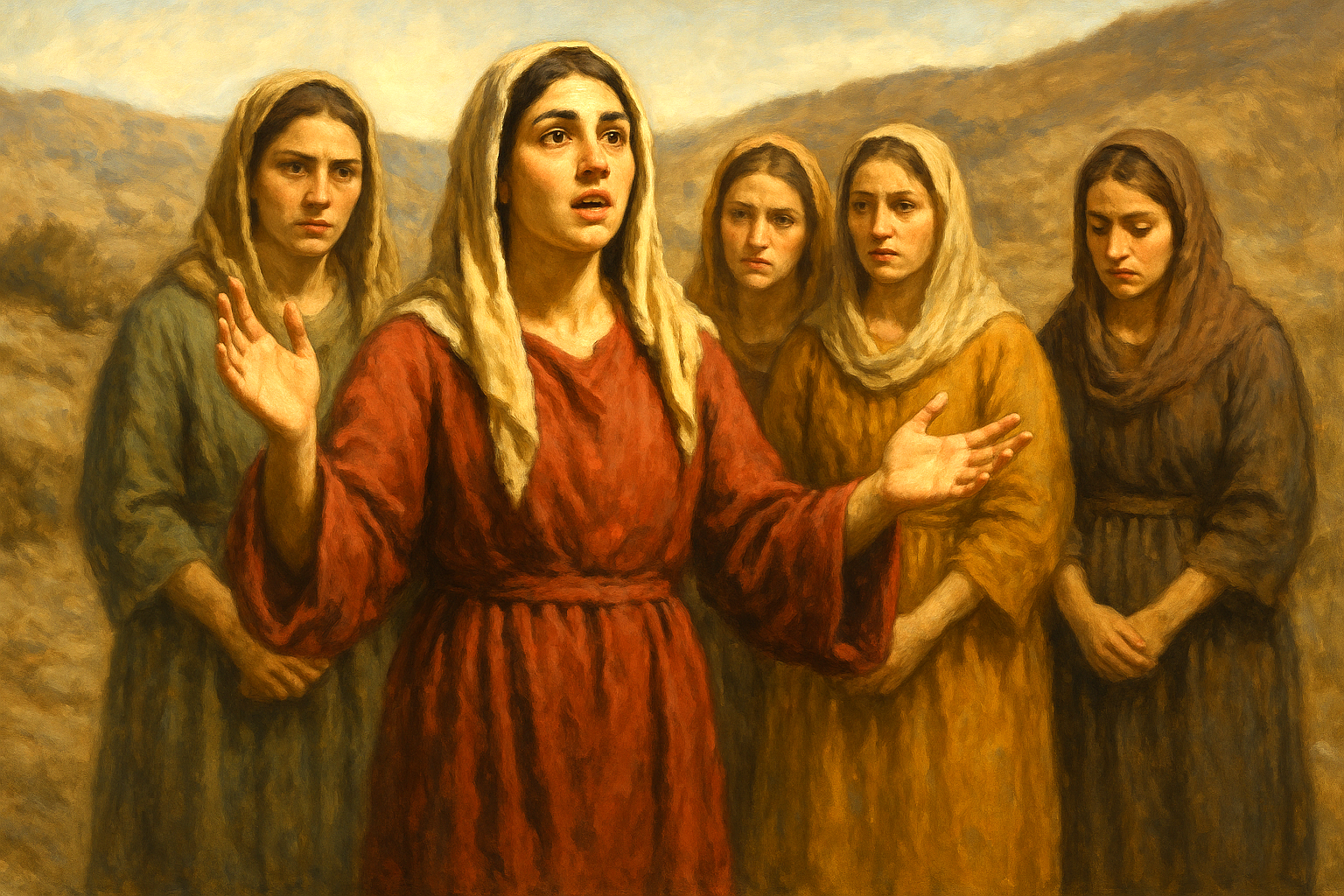
Zelophehad, from the tribe of Manasseh (descended from Joseph, one of Jacob’s twelve sons), died during the Israelites’ forty-year wilderness journey, leaving behind five daughters: Mahlah, Noa, Hoglah, Milcah, and Tirzah.
Without sons, their father’s name and future inheritance in the Promised Land were about to vanish. But these young women weren’t about to let that happen.
In that fortieth year since leaving Egypt, and the Israelites were preparing to enter Canaan, the Promised Land. Moses took a census of all the men over twenty—601,730 in total—to divide the land by tribe. Each man would receive a portion to pass down to his sons.
Imagine realizing that your family’s land will go to someone else simply because you’re female. So, the sisters made a bold and unprecedented decision: they would petition the leaders of Israel.
The Boldness of Zelophehad’s Daughters
Picture the scene: Moses, the priest Eleazar, and the elders sit near the Tabernacle—the sacred center of Israel’s camp, an area filled with men.
And then, in walk five young women.
You can almost hear the murmurs ripple through the crowd: “What are they doing here?”
But these women didn’t shrink back. They stood tall and presented their case, straight to Moses:
“Our father died in the wilderness. He was not among Korah’s followers, who rebelled against the Lord, but he died for his own sin and left no sons. Why should our father’s name disappear from his clan because he had no son? Give us property among our father’s relatives.” (Numbers 27:3–4 NIV)
They made their case respectfully, and with conviction. And honestly, I think Moses was thrown for a loop. There was no precedent—no law that said what to do if a man died without sons.
So, Moses did the best thing a leader can do when he doesn’t know what to do.
He took it to God. And God’s response?
“The daughters of Zelophehad are right.” (Numbers 27:7 NIV)
Let’s pause there for a moment. God didn’t just approve the request—He affirmed them. Their reasoning reflected His heart for fairness and family preservation. Next, God then gave Moses new instructions for the entire nation:
“If a man dies and leaves no son, give his inheritance to his daughter.” (Numbers 27:8 NIV)
This one brave petition changed the law of inheritance for all of Israel. When Joshua later divided the land (Joshua 17:3-6), the daughters’ names are listed again as they received their inheritance—just as God promised.
Why This Story Is So Extraordinary
These women weren’t rebels. They were faithful, respectful, and prepared. They didn’t demand equality out of pride—they desired fairness out of faith. They believed God’s promises applied to them, too.
Their story reminds us that God notices injustice, even in the fine print of ancient laws. He listens when His people—yes, even young, unmarried women—come before Him with courage and conviction.
Let’s take a step back and look at some details that show just how wild this moment really was.
First, these weren’t seasoned women with life experience, and certainly not legal training. Since Numbers 36 later records that the leaders of Manasseh asked that these sisters marry within their tribe to preserve property lines, it’s likely the daughters were still unmarried—and perhaps even teenagers. Girls their age were expected to stay near the tents, prepare for marriage, and leave legal matters to the men.
Second, they had to study the laws to craft a solid, respectful argument. They must have asked questions, sought advice, and learned how inheritance worked to spot a gap no one else had noticed.
And then there’s the journey itself. The Israelite encampment spanned thousands of square miles—roughly 11,000 square miles—the size of Massachusetts! To reach the Tabernacle, they may have walked three to six days through dusty terrain and crowded tribal divisions.
What this Story Teaches Us
This biblical story has plenty of lessons that are still relevant for us today:
- Faith doesn’t always look like waiting quietly. Sometimes it means stepping forward and saying, “This isn’t right.”
- We can trust that God truly wants to hear about our problems. The sisters didn’t respond with anger or a sense of entitlement—they simply believed that God cared enough to hear them.
- When we face obstacles that seem immovable, we can follow their lead: prepare, speak with courage, and trust that God’s justice reaches every detail.
How amazing!
They did their research.
They spoke with confidence.
They honored God while asking for change.
And God honored them right back.
So yes—five young women stood before the nation’s highest authorities, argued a legal case, and changed history. That’s not just bold. It’s a little strange, but highly sacred.
Questions for Further Study
- What do you think gave these five sisters the courage to speak up when no woman had done it before?
- Why do you think God chose to make an example of their case rather than dismiss it?
- How does this story challenge our assumptions about what women could do in ancient times?
- What can we learn from their balance of boldness and respect when we’re asking for something right and just?
- Which part of their story—faith, preparation, courage, or obedience—speaks most to you personally?
Disclosure: The featured photo was created by AI to depict an aspect of this story.
Scriptures marked NIV are taken from the NEW INTERNATIONAL VERSION (NIV): Scripture taken from THE HOLY BIBLE, NEW INTERNATIONAL VERSION ®. Copyright©1973, 1978, 1984, 2011 by Biblica, Inc.™. Used by permission of Zondervan
References: (1) My Jewish Learning, (2) Chabad.org, (3) Conforming to Jesus, (4) Answers.com










I'd love to hear what you think!