
Decorating your home is a great way to showcase your creativity. While it might seem a bit daunting, the beauty of home décor is that you don’t need to buy new items, be a DIY enthusiast, or spend a lot of money. Simple choices can make your space feel warm, inviting, and uniquely yours.
Rather than focusing on entire rooms or walls, think smaller with color, texture, and vignettes.
Choosing the Right Color
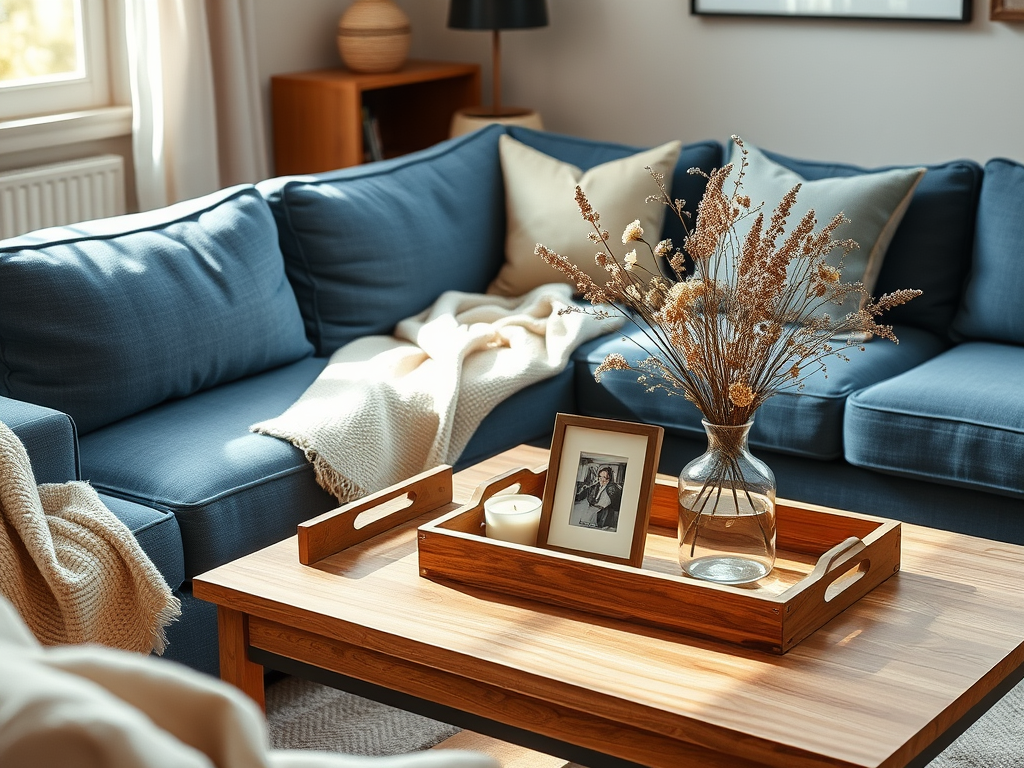
I’ll be honest — decorating has never been my strong suit. I can pick out clothes just fine but put me in charge of colors in my own house and I start second-guessing everything! When we got a solid blue sectional in our living room, I thought the “rule” was that every decor piece had to include some blue. I kept trying to make things coordinate, even though deep down I knew the whole “matchy-matchy” look was not my personal style.
Over time, I’ve learned that decorating isn’t about matching everything—it’s about creating balance. Rather than repeating the same color everywhere, I pick one color to be the “star” of a small space and let the rest of the elements quietly complement it, sometimes with a subtle supporting hue.
For example, decorating a simple corner might include:
- a wooden tray or basket (natural warmth)
- a neutral item like a cream candle or book
- one small object in your chosen accent color
The main color doesn’t have to be bold. In fact, a small pop of color often looks more intentional.
A helpful starting point: Pull colors from something you already love — a pillow, framed print, quilt, or even the cover of a favorite book. Let that item guide your choices instead of trying to invent a color scheme from scratch.
You’re not decorating the whole room. You’re creating a tiny visual resting place for your eyes.
Thinking About Textures
Do you have a room that looks nice but somehow feels… flat?
This is usually not a color problem — it’s a texture problem.
Texture is what makes a space feel comfortable instead of staged. Some textures you can feel (like a soft throw blanket), and some you simply see (like woven baskets or greenery). Both matter.
Here are a few common texture types you’ll notice around your home:
- Soft: velvet, cotton, wool, or linen — pillows, rugs, and throws
- Hard: glass, wood, or ceramic — vases, trays, lamps, and candles
- Natural or Organic: bamboo, rattan, natural wood, stone, and plants
- Metallic: brass, gold, or copper accents
- Patterned: fabric or paper designs that add visual depth
Rooms feel inviting when different textures work together. If every surface is smooth — painted wood, metal, glass — the space can feel cold even if the colors are beautiful. But when a soft blanket rests near a wooden tray, or a small plant sits beside a lamp, the space instantly feels more welcoming. Again, that’s balance.
A helpful starting point: look at your small area and ask, does everything feel the same?
If it does, add just one different texture. A basket, a folded throw, a small plant, or even a stack of books can bring warmth without changing your entire décor.

Creating Attractive Vignettes
Think of a vignette as a story told through your decor. It’s simply a small grouping of objects—not a permanent arrangement. You can move things around until it feels right to you. By selecting textures and a few carefully chosen pieces, you create an accent that adds style to your home and brings you joy.
Let’s start with planning one vignette in just one room of your home.
First, look at the surface you want to use—a side table, shelf or corner. If it already feels crowded, remove a few items so the space has room to breathe.
Now begin building:
- Start with three items. An odd number feels natural and creates visual balance.
- Choose one as your anchor piece — the focal point — such as a frame, lamp, or vase.
- Add something personal: a photo, memory piece, or meaningful object.
- Create a base. A tray works well, but a fabric placemat, stack of books, or even a small table can work.
- Vary the heights so everything isn’t level. If one piece is tall, keep the others shorter.
- Mix textures and materials — for example, a wooden tray paired with a ceramic item or greenery.
- Arrange the items in a gentle triangle rather than a straight row. This guides the eye naturally.
- Leave a little breathing room so each piece can stand out.
When you’re finished, step back and look at it from across the room. If something feels off, simply move one item and try again. Decorating a vignette isn’t about getting it perfect — it’s about noticing what feels welcoming to you.
Shopping for Decor with Confidence
Decorating a home rarely happens in one shopping trip. Most inviting homes are collected slowly, one small piece at a time.
Thrift stores may seem like an obvious choice, but they aren’t always close by. Even small resale shops or church sales can have clean, well-cared-for items that are easy to experiment with.
When pieces are affordable, you don’t feel locked into the decision. You can try something, live with it a while, and move it somewhere else later.
Take photos of your home and jot a few measurements in the photo description so you don’t have to rely on memory later. It saves you from bringing home something you love, only to discover it doesn’t fit the space.
Snap photos of your seasonal decor, not just for Christmas but for any occasion. Once you’ve finished decorating, capture each area. You’ll start to see what you naturally gravitate toward — and decorating feels more natural every year.
Before you go shopping, walk through your home and gather a few items from other rooms — a book, a candle, a small basket, a plant, or a frame. Sometimes a new arrangement, not a new purchase, is all a space needs.
A welcoming home isn’t about perfect decorating. It develops over time as you discover what you love and allow yourself to experiment. A small corner, a simple arrangement, or a meaningful item placed where you’ll see it each day can bring more comfort than a fully redesigned room. Start with one small space, adjust it as you go, and let your home reflect the life being lived inside it.
Disclosure: Featured photo was created with AI in order to illustrate the topic of this blog post.








I’d love to hear what you think!