
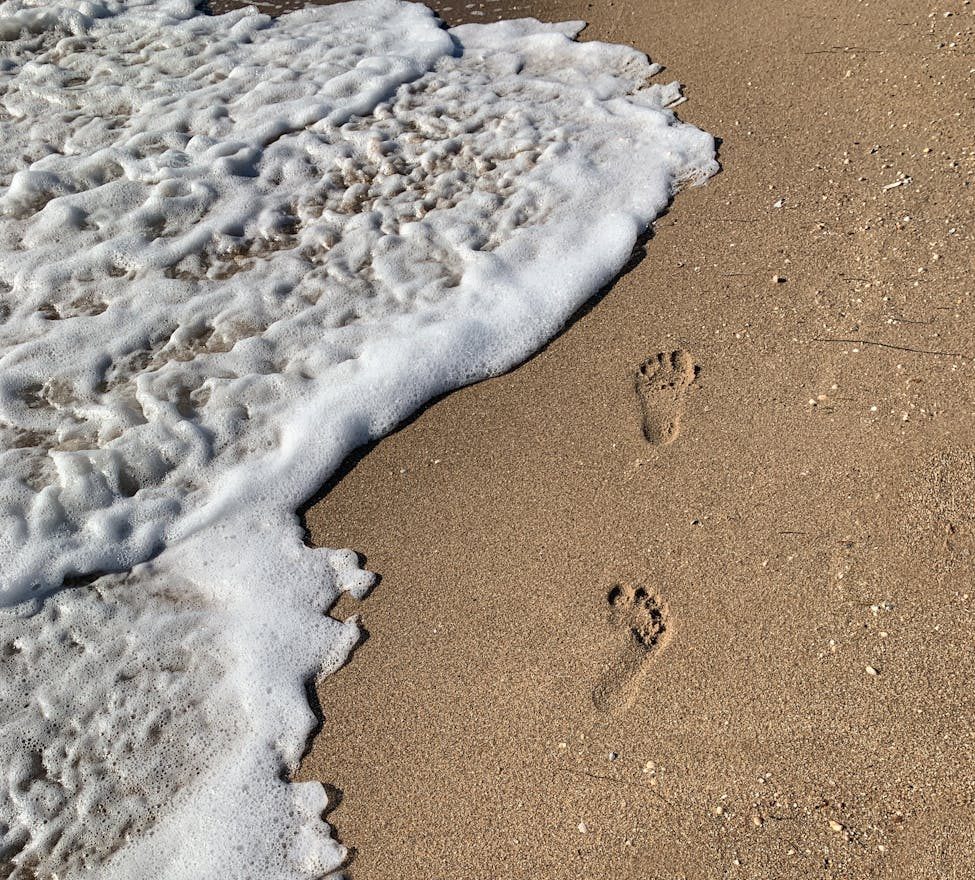
Whether you’re familiar with Christian culture or not, you’ve likely seen this beloved poem on a bookmark or framed print.
It wasn’t too long ago that I came across this poem on a bookmark that I have had since high school. On my bookmark, it is attributed as “author unknown.”
How is it that this famous poem can’t be attributed to a single poet?
Curious about its mysterious authorship, I began searching for answers—only to find conflicting claims, legal battles, and a tangled backstory.
Two versions of “Footprints”
The poem I know best is the one posted below. However, I didn’t realize there were two versions of the poem. The second is a slightly different version, “Footprints in the Sand,” written in first person.

Who is the author of “Footprints?”
While it is sometimes referred to as “author unknown,” an original, handwritten copy of the poem was discovered by Basil Zangare, which insists that it was written by his late mother, Mary Stevenson, in 1936, during the Great Depression. (She died in 1999.) After it was found, Stevenson filed a copyright claim in 1984.
Zangare filed the lawsuit in 2008 against two other women who claim to be the poem’s sole author and copyright holder. These women have made money from the poem; Zangare states that his mother did not.
Follow the money.
According to a story in the Washington Post, one of the defendants, a Canadian poet named Margaret Fishback-Powers, said she wrote the poem in 1964 while at a youth retreat. She sold the poem to HarperCollins in a 1992 book deal, with her account of how she “wrote it, lost it, and rediscovered it once the world had already been moved to hang it on refrigerators and church youth room walls.” Powers has a registered trademark for “Footprints” and “Footprints in the Sand” but claims she has made little money from the poem.
Carolyn Joyce Carty is the other defendant in the suit. Her stance is that she wrote the poem in 1963 – when she was six years old – then stated that her grandmother wrote it in 1922. Carty also filed a copyright on the poem, and a collection of her poetry published in 2004 states that she is the Footprints author. She has also monetized her version of the poem.
As I researched, details on Powers, Carty, and the poem’s origin vary, depending on what website you read, including Wikipedia.
Although Zangare’s lawsuit is against Powers and Carty, there are still others who want to be called the author of the poem. In addition, variants of the poem have been used in many publications and music.
Ultimately, I found no definite information about who won the lawsuit. There were complications, including that the alleged original document of Stevenson’s was lost in an overnight delivery, and that Zangare waited too long to sue. Stevenson’s registered copyright doesn’t prove absolute authorship, although there are many attributions to Stevenson as the rightful author of the “Footprints” version of the poem.
Interestingly enough, a Brooklyn journalist and literary sleuth named Rachel Aviv, traced elements of the poem to a sermon in 1880 – so it could be that nobody really wrote the poem. (Washington Post)
In the end, the poem has gained popularity because of how it touches the heart. “Footprints” reflects how we feel alone when things go wrong, and our faith is shattered. The overall promise of the poem is simply the words of God, who reminds us of many times in the Bible that He will never leave us or forsake us.
My bookmark will stay in my Bible for its inspiration and reminder that we follow a God who sees us, is with us, and always know what is best for us.

Disclosure: Photos are property of Angie Vallejo and may not be used without permission.








Leave a Reply to Diana WalkerCancel reply