
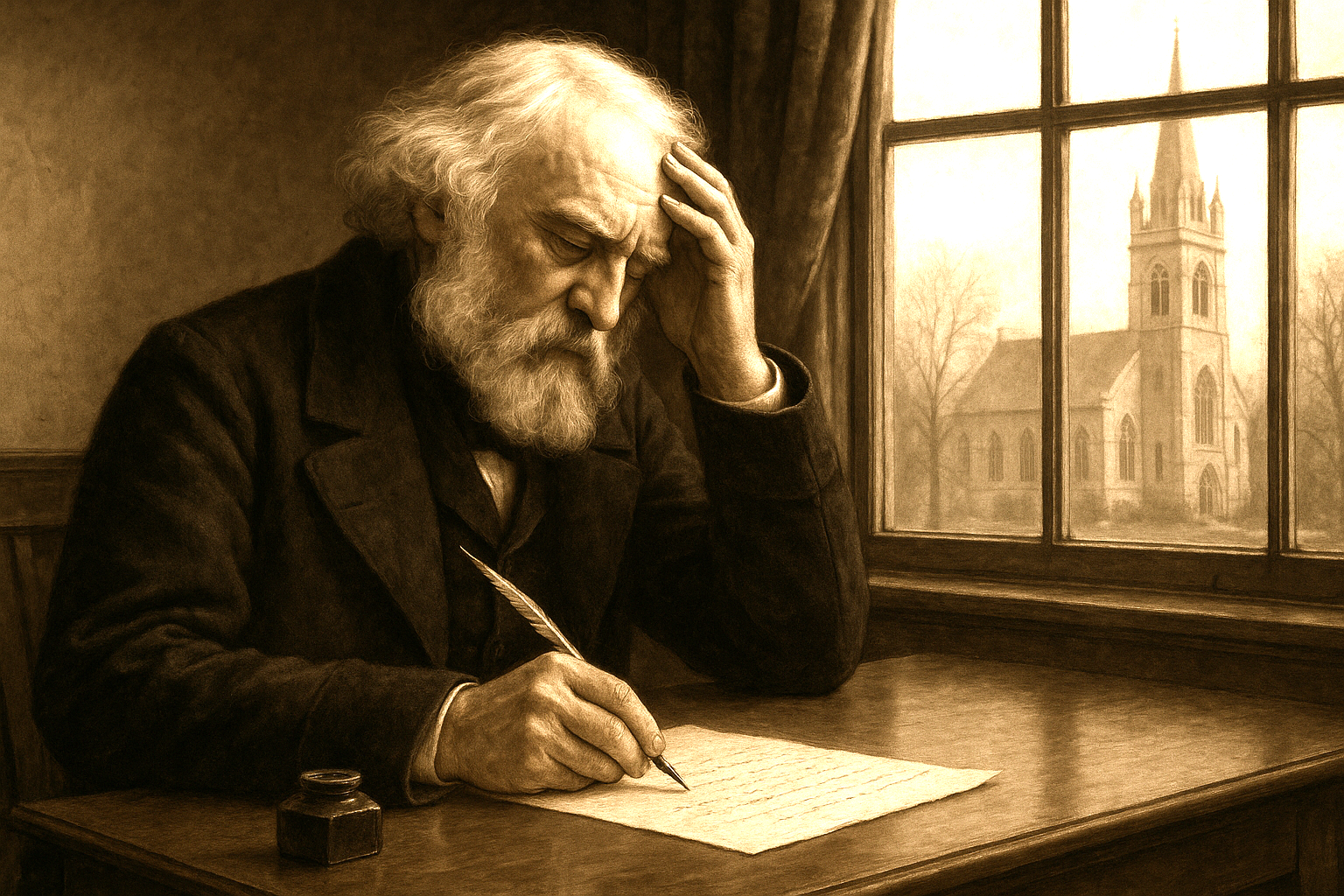
Part One • Real Stories Behind Beloved Christmas Hymns
Growing up playing the piano, my favorite songs to play were the Christmas hymns. I loved all of them, whether the regular hymns, or adaptations.
As we enter the season of Advent, I’m sharing fascinating, behind-the-scenes stories of three Christmas hymns—and what their lyrics really represent. Each one carries a message of faith, hope, and redemption that reaches far beyond the melody. This week, we’ll begin with the moving story behind “I Heard the Bells on Christmas Day,” written by poet Henry Wadsworth Longfellow during one of the darkest seasons of his life.
“I Heard the Bells” Written by a Celebrated Poet
By the mid-1800s, the world was well-acquainted with Henry Wadsworth Longfellow, one of America’s most renowned poets. He penned several touching works, including “The Day is Done” (1845), “The Children’s Hour” (1863), and most famously, “Paul Revere’s Ride” (1861). His poetry often explored themes of nature, emotion, and romanticism, while also examining moral and spiritual ideas.

How this Poem Was A Result of Tragedy
Despite his literary fame, nothing could have prepared him for the tragedies that lay ahead.
In July 1861, a horrific accident occurred when his wife, Fanny, was sealing envelopes with hot wax, and her dress caught fire. Longfellow rushed to save her, doing everything he could to extinguish the flames, but her burns were too severe. She passed away the next morning. Longfellow himself was so badly burned that he couldn’t attend her funeral. The scars he bore led him to grow a beard, which later became his signature look.
Longfellow bore deep emotional scars from his immense grief. His depression was so intense that he feared being sent to an asylum. In his journal, he sorrowfully wrote, “I can make no record of these days. Better to leave them wrapped in silence. Perhaps some day God will give me peace.” On Christmas 1862, he recorded, “‘A merry Christmas,’ say the children, but that is no more for me.” He later wrote the poem “The Cross of Snow” as he continued to mourn for Fanny.
In March 1863, Longfellow’s eldest son, Charles, just 18 years old, secretly left home to enlist in the Union’s 1st Massachusetts Artillery without his family’s knowledge. Fortunately, his father’s influence helped him gain a promotion to second lieutenant that may have saved him. He had several narrow escapes—he guarded wagons instead of engaging in combat during the Battle of Chancellorsville and fell ill with camp fever, which kept him from fighting in the bloody Battle of Gettysburg. In November 1863, Charles suffered a shoulder injury during the Mine Run Campaign, with the bullet narrowly missing his spine. He spent six months recovering at home, and the injury brought his military service to an end.
The Bells of Cambridge Inspired the Poem
On Christmas in 1964, Longfellow listened to the bells of Cambridge ringing out their familiar message of “peace on earth, good will to men” (Luke 2:14). But these words brought him no consolation. Burdened by personal grief and the harsh reality of a nation torn by war, the phrase felt bitter and hollow. Yet, a spark began to ignite within him—words that started to lift his despair toward a glimmer of hope. True to his style, he poured out the depths of his sorrow and yearning for peace through his writing.
I heard the bells on Christmas Day
Their old, familiar carols play,
And wild and sweet
The words repeat
Of peace on earth, good-will to men!
And thought how, as the day had come,
The belfries of all Christendom
Had rolled along
The unbroken song
Of peace on earth, good-will to men!
Till ringing, singing on its way,
The world revolved from night to day,
A voice, a chime,
A chant sublime
Of peace on earth, good-will to men!
Then from each black, accursed mouth
The cannon thundered in the South,
And with the sound
The carols drowned
Of peace on earth, good-will to men!
It was as if an earthquake rent
The hearth-stones of a continent,
And made forlorn
The households born
Of peace on earth, good-will to men!
And in despair I bowed my head;
“There is no peace on earth,” I said;
“For hate is strong,
And mocks the song
Of peace on earth, good-will to men!”
Then pealed the bells more loud and deep:
“God is not dead, nor doth He sleep;
The Wrong shall fail,
The Right prevail,
With peace on earth, good-will to men.”
Just ten years later, in 1872, English organist John Baptiste Calkin set portions of this poem to music, transforming it into a message of hope.
How a Beloved Hymn Received New Life
It wasn’t until 1956 that this poem would be revived in Contemporary music. Writer Johnny Marks, already famous for songs like “Rudolph the Red Nosed Reindeer,” and “Rockin’ Around the Christmas Tree,” created another version of from the soulful poem, and was recorded by famous crooner Bing Crosby.
This Song Brings Us Hope Today
Even though Longfellow wrote “I Heard the Bells on Christmas Day” during one of the hardest times in his life, his words still carry hope today. Many of us can relate to that quiet sense of despair during the holidays—when grief, loneliness, or the struggles of a broken world make the season’s joy feel distant. Like Longfellow, we might look around and question how peace can exist in the midst of so much pain and division.
The turning point in his poem—“God is not dead, nor doth He sleep”—serves as a reminder that even in times of sorrow, God’s presence remains with us. The same God who provided comfort to His people in Scripture still offers that peace today. Just as the bells rang loud and deep for Longfellow, they can resonate in our hearts, reminding us that Christ came to bring peace not only to the world but also to each of us individually.
On Christmas, we celebrate the arrival of the Messiah—the true Gift of peace and hope. In a world that often feels cold and chaotic, Jesus has called us out of our darkness and into His marvelous light (1 Peter 2:9). As we bring our weariness, loss, and longing to Him, He wraps us in His comfort and renews our faith that “the wrong shall fail, the right prevail.”
During this Christmas season, let the sound of the bells remind you that God is always close. His peace doesn’t come from perfect situations but from the perfect Savior who came to heal a broken world.
Disclosure: The featured image was created by AI in order to illustrate this particular post. Images of Henry Wadsworth Longfellow are based off historical images.










I'd love to hear what you think!