
Read Joshua 2:1–21; 6:22–23
“Faith never knows where it is being led;
it knows and loves the One who is leading.”
— Oswald Chambers
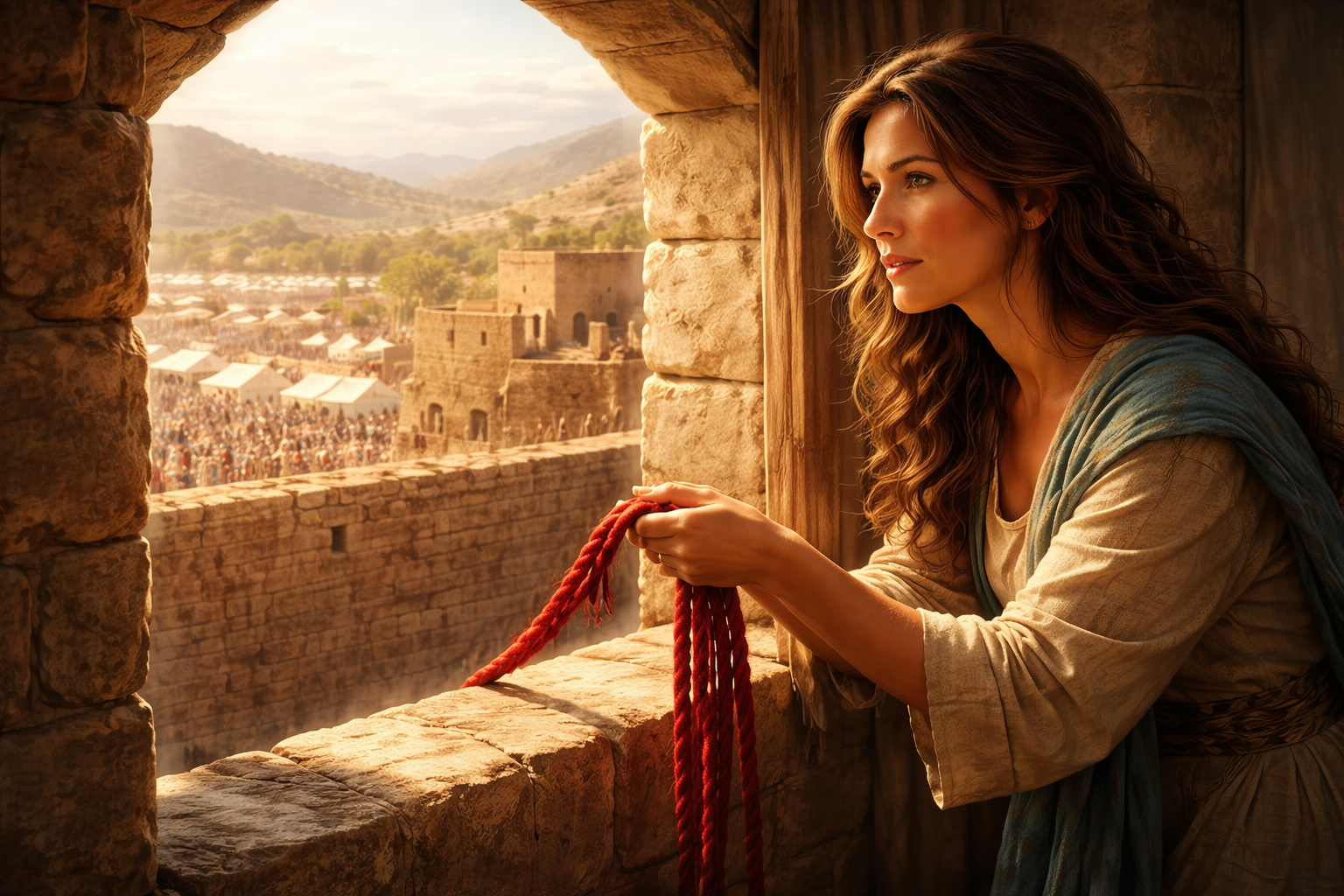
The noise outside her home, built into the city wall, was deafening.
Shouts and screams echoed through the streets as stones cracked and fell, the wall itself collapsing in roaring waves. The city of Jericho was coming apart at the seams.
There were fists pounding on her door —pleas for help, cries for refuge—but Rahab did not answer.
She waited.
Had she made the right decision?
Had she trusted the wrong people?
How long would she and her family have to wait?
Had she risked everything… for nothing?
Then she heard it—a scraping sound outside her window.
A face appeared. A man’s voice was urgent:
“Come. Now. There is not much time.”
One by one, Rahab and her family climbed through the window, gripping the red rope tied there as a sign of promise. Two men waited below, steadying them as they descended. Each moment felt endless—but finally, they were all safely on the ground.
And they ran.
Away from the falling city.
To the Israelite camp.
Toward safety.
Scripture is filled with stories of faith, but one of the most striking is Rahab’s. She believed in a God she had never seen and risked everything on a promise.
Let’s take a deeper dive into Rahab’s story.
A New Leader and an Impossible City
The book of Joshua opens with a major transition. Moses had died, and Joshua became the new leader of Israel with a promise from God:
“Be strong and courageous. Do not be frightened, and do not be dismayed, for the Lord your God is with you wherever you go.” (Joshua 1:9 ESV).
At this time, the Israelites were camped on the east side of the Jordan River. Directly across from them stands their first obstacle: the fortified city of Jericho.
Jericho was no ordinary city. Known as the “City of Palms,” it was one of the oldest cities in the world and strategically located along important trade routes. Fertile land and natural springs allowed agriculture and commerce to thrive.
But what made Jericho truly formidable were its walls.
The city was built on a raised mound surrounded by a massive earthen embankment. At the base stood a stone retaining wall about 12–15 feet high. On top of that rose a thick mudbrick wall reaching as high as 20–26 feet. Another wall protected the upper city, making the entire structure more than 40 feet tall from ground level.

Humanly speaking, Jericho seemed impossible to conquer.
Rahab’s Home in the Wall
Interestingly, many people actually lived within the walls. Houses were built along the embankment between the lower and upper sections, blending into the city’s defensive design.
Rahab lived in one of these houses.
Her home was positioned along the outer wall near the city gate—a perfect location for travelers entering or leaving Jericho. Because of this, her house functioned as a place where travelers could stop for lodging and rest.
Rahab was known throughout the city because of her profession. She was a woman people talked about rather than talked to. Her reputation likely separated her from her family and the rest of society.
Yet God often chooses unlikely people to accomplish His purposes.
Rahab’s Knowledge of God
Because travelers frequently passed through her home, Rahab heard the stories circulating throughout the Canaanite region about the Israelites:
- Israel’s escape from Egypt (Exodus 12:31-42)
- The miraculous crossing of the Red Sea (Exodus 14:5-31)
- The defeat of the Amorite kings Sihon and Og (Numbers 21:21-35)
By the time the Israelite spies arrived, Israel’s reputation preceded them, and Rahab was convinced that Israel’s God was the one true God. Her faith had been ignited by the stories of what He had done.
A Risky Act of Faith
Joshua sent two men to secretly scout the land, especially Jericho. Like many travelers, they ended up at Rahab’s house, likely hoping to gather information discreetly.
But news quickly reached the king of Jericho that spies had entered the city. He sent soldiers to demand that Rahab turn them over.
Instead, Rahab hid the spies on her roof beneath bundles of flax that had been laid out to dry.
A note for Bible nerds: Flax was an important crop used to produce linen—a valuable fabric in the ancient world. Its presence on Rahab’s roof may suggest that she also worked with textiles, spinning or selling linen as another source of income.
When the king’s men arrived, Rahab misdirected them:
“True, the men came to me, but I did not know where they were from. And when the gate was about to be closed at dark, the men went out. I do not know where the men went. Pursue them quickly, for you will overtake them.” (Joshua 2:4-5)
Her decision was incredibly dangerous. If discovered, she could have been executed for treason.
A Confession and a Promise
After the soldiers left, Rahab spoke to the spies and revealed what she believed:
“The Lord your God, He is God in the heavens above and on the earth beneath.” (Joshua 2:11)
In a city full of pagan temples and false gods, Rahab placed her faith in the one true God. By protecting the spies, she demonstrated that her newfound belief gave her the courage to act.
Before helping the spies escape, Rahab boldly asked for assurance that she and her family would be spared when Israel attacked Jericho.
The spies agreed and gave her one instruction: tie a scarlet cord in the window of her house and gather her family inside.
Another note for Bible nerds: The scarlet cord echoes the Passover in Egypt when the Israelites placed lamb’s blood on their doorposts so the angel of death would pass over their homes. In both cases, the sign represented God’s promise of protection and rescue.
After lowering the spies through her window with the rope, Rahab faced another risky mission—warning her family about the coming judgment and convincing them to take shelter in her home.
Waiting with Faith
Holding on to the promise made by the spies, Rahab secretly gathered her parents and relatives.
This was risky. Any one of them could have informed the king. Yet they trusted her and agreed to stay in her home and wait.
Rahab believed the promise, but rescue didn’t come immediately.
Sometimes faith requires waiting.
Days passed. Eventually the Israelite army arrived and began marching around the city—once a day for six days they circled the walls.
And still—no rescue.
Finally, on the seventh day, the army marched around the city seven times. The priests blew their ram’s horns, the people shouted, and the walls of Jericho collapsed.
But one section of the wall miraculously remained standing—Rahab’s home.
Just as promised, the spies returned and brought Rahab and her family safely out of the city.
A New Story for Rahab
Rahab’s story did not end with her rescue.
She and her family were welcomed into the Israelite camp. She married Salmon, one of the Israelites, and they had a son named Boaz.
But her story doesn’t end there.
Boaz later married Ruth, and their family line eventually produced King David—and ultimately Jesus Christ.
Rahab, a Gentile woman with a troubled past, is named in the genealogy of the Messiah (Matthew 1:5), and honored in Hebrews 11, the Bible’s “Hall of Faith.”
God did not erase Rahab’s past. Instead, He redeemed it and gave her a new story.
Lessons from Rahab’s Faith
Rahab’s story teaches us several important truths:
• It is never too late for a changed life.
• God can use anyone who places their faith in Him.
• Faith is demonstrated through action.
• True faith cares about the salvation of others.
• God’s promises are always fulfilled.
When God gives a promise, He also gives a purpose. Even when we feel uncertain about the direction of our lives, God still calls us to walk in His ways, love Him, and serve Him with all our heart and soul. Our purpose remains the same—to live out the words of Jesus and share them with others.
You may have a situation that feel like a Jericho—with walls that seem impossible to overcome on your own.
But God specializes in bringing down walls.
“And we know that for those who love God, all things work together for good, for those who are called according to His purpose.” (Romans 8:28 ESV)
Faith doesn’t always mean seeing the outcome immediately. Sometimes it means trusting God while we wait.
Joshua led Israel into the Promised Land, but Jesus leads us into an even greater promise—eternal life with Him.
And like Rahab, anyone who places their faith in Him can experience a completely rewritten story.
Questions for Journaling:
- Rahab risked her life to protect the spies. What does her courage teach us about the difference between believing in God and acting on that belief?
- The scarlet cord was a visible sign of Rahab’s faith. What are some ways our faith becomes visible in our everyday lives?
- Rahab had to wait for the promise of rescue while the Israelites marched around Jericho. What helps you trust God during seasons of waiting?
- Rahab’s past did not prevent God from using her in His plan. What does her story teach us about God’s grace and redemption?
Disclosure: The diagram of the Jericho wall was created by AI based on dimensions based on my research to give better understanding of the text. Note that AI does sometimes makes mistakes.








I’d love to hear what you think!