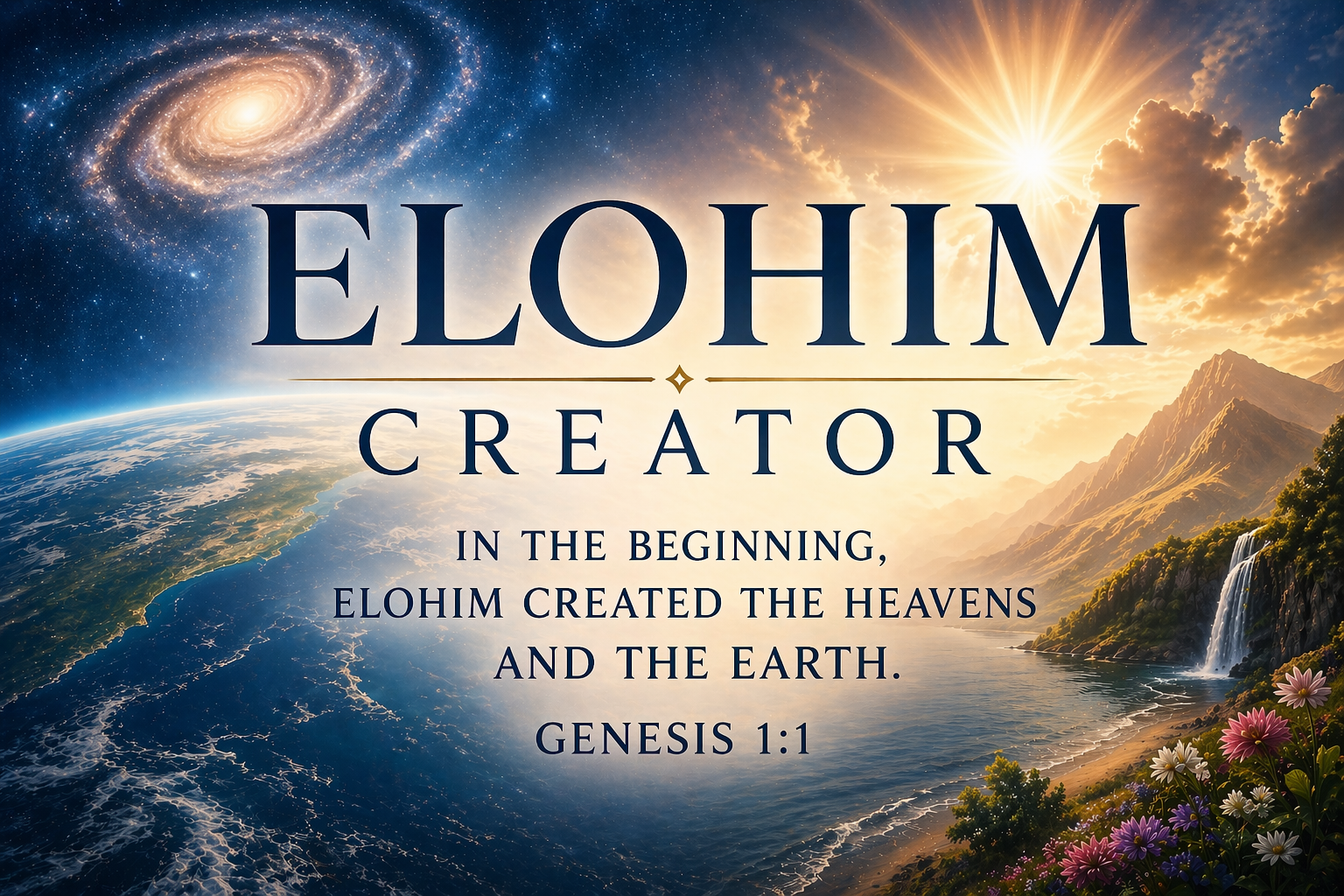
Part 1 of the “Names of God” Bible Study Series
In the beginning, Elohim created the heavens and the earth. (Genesis 1:1)
Elohim: What This Name Means
The name Elohim is the very first name used for God in the Bible—and that’s not accidental. Elohim means the “one true God”—strong, powerful, and completely sovereign.
It’s used over 2,500 times in the Old Testament and points to God as:
- Creator
- Sustainer
- Infinite
- Supreme authority over all things
In Genesis 1, we see His power immediately: He spoke—and the world was created. He brought into being what did not exist. He called light to break through darkness.
And—He created us in His image.
This is who our God is.
Elohim—great and almighty.
Why This Matters
It’s easy to read Genesis 1 and think, “Of course God created the world.”
But pause for a second.
The same Elohim who: spoke light into darkness, created something out of nothing and holds the universe together…
…is the God you can trust with your life right now.
Jeremiah the prophet prayed:
“Ah, Sovereign Lord, you have made the heavens and the earth by your great power and outstretched arm. Nothing is too hard for you.” (Jeremiah 32:17 NIV)
That means nothing in your life is beyond His power, no situation is too far gone, and no season is too empty for Him to bring something new into being.
Nothing is too hard for God.
Going Deeper
We witness the power of Elohim in creation, but we also encounter His name in a profound moment at the Cross.
Just before He breathed his last, Jesus cried out in a loud voice,
“My God, my God, why have you forsaken me?” (Mark 15:34, Psalm 22:1)
The word He uses? A form of Elohim.
When Jesus echoed this opening from David’s psalm, those words became a prophecy fulfilled in the suffering Messiah.
It wasn’t doubt—it was a real, human cry in the middle of unimaginable weight as Jesus bore the sins of the entire world.
For Bible Nerds (Like Me):
There’s something interesting I learned about the word Elohim.
It’s actually plural in form, but it’s used with singular verbs when referring to the one true God. This is often called a “plural of majesty” — a way of expressing greatness, authority, and fullness.
But there’s more.
The plural form—paired with God’s oneness—hints at something we understand more clearly later: God is one … yet revealed as Father, Son, and Holy Spirit.
We see small glimpses of this early in Genesis:
In Genesis 1:26, God says, “Let us make mankind in our image, in our likeness…”
and again, in Genesis 3:22, “The man has now become like one of us…”The Old Testament doesn’t fully explain this yet, but it points forward.
Later, passages like Isaiah 48:16–17 begin to bring more clarity. And in the New Testament, we see it revealed fully —like at Jesus’ baptism, where Father, Son and Holy Spirit are all present at once. (Matthew 3:16-17)
So, while the word Trinity isn’t used in Scripture, the truth of it is woven throughout—from the very beginning.
Don’t Miss This
When you read “In the beginning, Elohim created…” it’s easy to keep reading—but don’t rush past it.
The God who created everything you see—every star, every body of water, and every detail of your life—is not distant, distracted, or limited.
He is Elohim.
And if He can create something out of nothing…He can still do that in your life. Even now.
Journaling Prompts
- Where do I need to remember that God is powerful—not just present?
- How does seeing God as Creator change the way I view my current season?
- What would trusting Elohim actually look like for me this week?
Color-Coding Suggestion
Theme: God’s Character → Creator / Power
(Use your assigned color for God’s character and mark Jeremiah 32:17.)
Disclosure: The featured image was created by AI based on the subject of the post. Please note that AI does sometimes makes mistakes.